Far from the bustle of Taipei, Kate grew up in a house perched in the hills of Jinguashi (金瓜石), where fog sometimes erases the city below entirely.
The climate there is a particular one. Taiwan is a subtropical island swept by monsoon rains, where humidity lingers in the valleys and rainfall has long shaped local food habits. Fermenting, salting and drying food became part of everyday life, out of necessity as much as tradition.
That constant humidity, and the slower rhythm of mountain life, shaped Kate’s entire way of seeing the world and, much later, her way of healing.
Her husband comes from both Hokkien and Hakka backgrounds, two major Han Chinese communities that have shaped Taiwan over centuries. Kate’s own grandparents came from mainland China and belonged to what is known in Taiwan as the Waishengren (外省人), families who arrived from mainland China around the end of the Chinese Civil War.
The distinction is an important part of Taiwan’s modern history. Hokkien and Hakka families who had been established on the island before 1945 were generally considered Benshengren (本省人), literally “people of this province”, while those who arrived from mainland China after 1945 and their descendants came to be known as Waishengren, or “people from the outside provinces”. These are historical and social categories rather than strictly defined ethnic groups, and today many Taiwanese families have mixed backgrounds.
For Kate and her husband, those different family histories meet within the same island.
In a way, we come from two different Taiwans, and yet it’s the same island that raised us both.
Taiwan holds an enormous diversity, and people of different backgrounds, different temperaments, and different possibilities can all grow and be nurtured on this island. To me, Taiwan is a little like a mother with great capacity to embrace.
Having become an artist at a young age, Kate spent years searching for a balance she couldn’t find anywhere, neither in the noise of the city nor in the silence of the mountains.
The answer came from an unexpected place.
Her plate.
When Kate discovered veganism in her late twenties, it began with something very simple: she no longer wanted to eat animals.
What started as an ethical choice gradually became something much deeper. She describes an almost immediate transformation: less inflammation, more mental clarity and, above all, the end of a diffuse frustration that had followed her since adolescence.
What could have remained a personal dietary choice became a calling.
Kate explored meditation, breathwork and bodywork, gradually devoting herself to helping others through what she herself had experienced.
Veganism taught me to listen to my body instead of fighting it.
Today, she runs workshops combining these approaches, convinced that healing rarely comes through a single door. For her, reinventing the dishes of her childhood, without betraying them, is fully part of that work.
The food remains connected to where she comes from, even when the ingredients change.
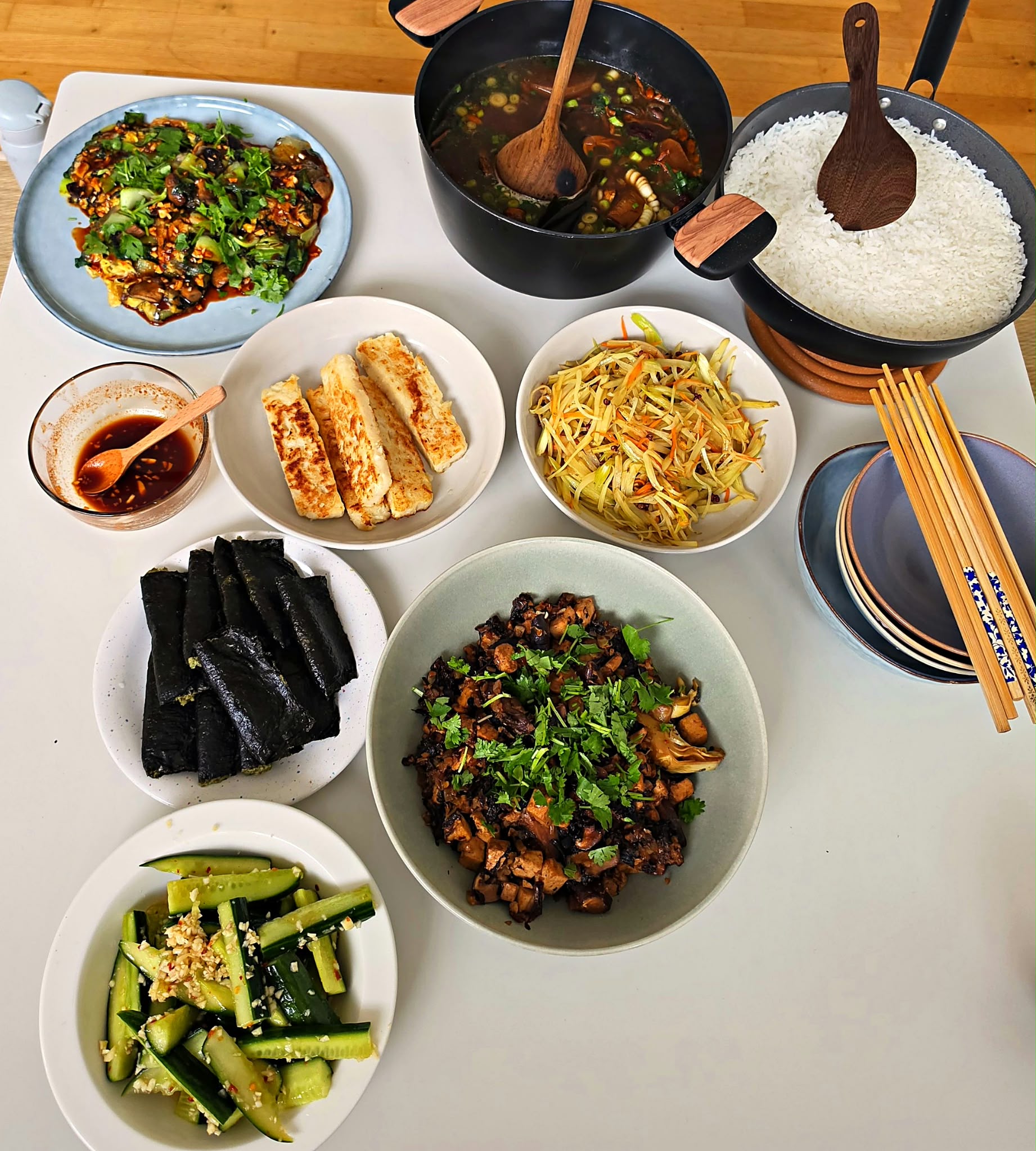
Fish has disappeared in favor of seaweed and pumpkin seeds, which bring that same briny taste and that same element of surprise to the palate. The idea is not to erase the familiar flavours, but to find another way of reaching them.
She served me her vegan version of a Taiwanese oyster pancake (蚵仔煎), a dish deeply associated with Taiwan’s street-food culture. The traditional egg is replaced with tofu skin, combined with starch and other plant-based ingredients, then seared until it reaches a familiar elastic, slightly crisp texture.
It is a small example of what happens throughout Kate’s approach: tradition is not abandoned, but reinterpreted.
And yet, what stays with me most from that visit isn’t the food alone. It is Kate herself.
There is an immediate warmth to her, a way of being humble without ever fading into the background, and an attentiveness to others that never feels calculated.
She and her family welcomed me with a hospitality so simple and so complete that it alone was enough to convince me to go and discover Taiwan without delay.
An island she speaks of with such quiet tenderness. An island whose people, she promised me with a laugh —
Welcome you as if you were already family.
A little over a year ago, Kate’s life took a radical geographical turn. She moved to Finland with her family so that her husband, a musician, could pursue his studies at the Sibelius Academy in Helsinki. Their seven-year-old daughter came with them.
It was a choice that took courage: leaving the mountains that raised her for a country where winter daylight can fade by early afternoon.
It was a big leap.
The move brought her into a completely different environment, but also into a culture with some unexpected points of connection. In Helsinki, Kate continues her wellness work, seeking to bridge the practices she developed in Taiwan with Nordic wellness culture.
The similarities can be surprising.
Silence. Nature. Slowness.
A certain understanding that wellbeing can come from stepping away from the noise of everyday life. And yet the differences are equally important.
Kate is not simply transferring one culture into another. She is discovering how the two can meet, while keeping the practices and perspectives that shaped her.
Perhaps that is also part of what makes her journey interesting: she has spent much of her life moving between different forms of balance.
Between the city and the mountains. Between artistic expression and bodily awareness. Between traditional food and veganism. And now, between Taiwan and Finland.
Her own life seems to reflect the philosophy she has developed through her work: sometimes, you have to step out of balance to find a new one, a truer one.
Don’t look for a miracle fix. Look for what your body has been trying to tell you for a long time and that you’ve learned to stop listening to.
Perhaps, ultimately, that is where Kate’s journey began, not with veganism, meditation or bodywork, but with learning to listen. To her body. To food. To the environment around her. And to the quiet signals that can sometimes tell us when it is time to change direction.