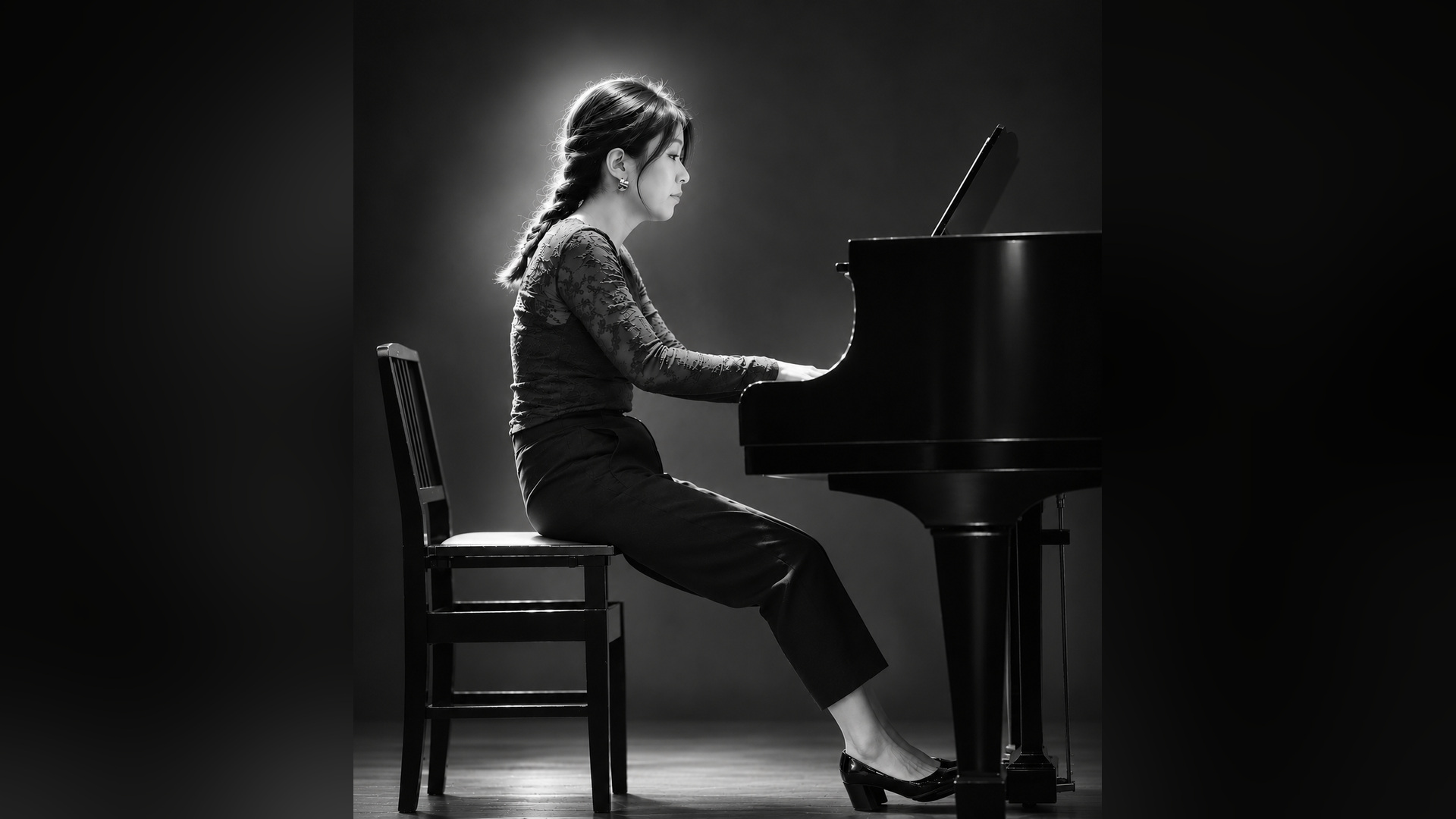
Sometimes, the most interesting encounters happen when you least expect them.
I met Mariko completely by chance, in the street. She was simply waiting for her daughter to finish her nap. We started chatting and, quite spontaneously, I invited her to my home to talk about Japan. And to my surprise, she accepted!
Before coming, she warned me that she might not really fit the profile of the people I was looking for in my project. After all, she had spent twenty years in the United States as a pianist before moving to Finland to teach at the Sibelius Academy.
But for me, that was precisely what made her story so interesting.
Looking at Japan from a different perspective
Mariko is, in many ways, deeply Japanese. In her habits, her way of thinking and those little details that are sometimes difficult to explain. Yet, after spending twenty years in the United States and now living in Finland, she has developed a fascinating ability to look at her own country from a different perspective.
What I particularly enjoy about our conversations is that we don’t always see Japan in the same way.
While I tend to be fascinated by Japanese traditions, the attention to detail and certain aspects of its social culture, she brings a more personal and sometimes questioning perspective, shaped by her experiences of living in different countries.
She has helped me understand that some traditions and social expectations, which may seem beautiful or intriguing from the outside, can also feel quite different to those who have grown up with them.
And I find that contrast fascinating.
Because I don’t want to discover only the Japan I imagine or admire. I also want to understand how people experience their own culture, what they value, what they question and how their perspectives evolve over time.
Through our conversations, she has taught me so much about a Japan that you don’t necessarily find in books or documentaries. The little things in everyday life, the words people choose, the things they prefer not to say, the gestures, the habits and all those invisible rules that shape relationships.
Sometimes her explanations confirm what I find beautiful about Japanese culture. Other times, they make me reconsider my own assumptions.
And that is exactly what makes these conversations so valuable to me.
To me, understanding a culture is not just about knowing its history or traditions. It is also about understanding how people think, communicate and live together.
And Mariko has this wonderful ability to explain these things naturally, sometimes with a lovely sense of humour.
Rediscovering Japan through food
Since Covid, Mariko has developed a deeper interest in traditional Japanese food, rediscovering the roots of her own culinary culture.
I find it interesting that after spending so many years abroad, she has become increasingly curious about traditions that were always part of her cultural background.
And thanks to her, I learned how to make my own natto! Those rather peculiar fermented soybeans that I have grown to love.
Now I can enjoy homemade natto almost every day, which, for someone as passionate about fermentation as I am, is quite a gift!
What I particularly appreciate is that she doesn’t simply share her knowledge. She takes the time to explain, to demonstrate and to encourage others to try things themselves.
And I have certainly benefited from that generosity!
The extraordinary discipline behind the music
There is another side of Mariko that fascinates me just as much: her dedication to music.
I had the chance to see her perform in concert, and I must say, watching her was almost hypnotic.
There was something about the way she played that made me feel she was somewhere else entirely. Completely absorbed, almost in a trance, as though the piano and the music had become part of her and everything around her had disappeared.
I know how many hours she spends practising, repeating passages and working on the smallest details. And when you see her on stage, you understand why.
All that patience, discipline and hard work become something that seems so natural, almost effortless, yet incredibly moving.
I sometimes wonder where that determination comes from. Her Japanese upbringing? Her culture? Her personality? Or simply a lifetime devoted to music?
Probably a mixture of all of them.
But whatever the reason, I find that level of dedication truly impressive.
A kindness that goes beyond words
But what touches me perhaps even more is that, despite all this dedication to her career, she never seems to lose her interest in other people.
Between her family, her teaching, her concerts and the countless hours she spends practising, I honestly don’t know how she manages to find any free time.
Yet, somehow, she always does.
Whenever I need advice, have a question or simply want to understand something better, she is there. Ready to listen, to explain, to share what she knows or to help in whatever way she can.
And what I find particularly beautiful is that her kindness seems so natural.
She never makes me feel that I’m bothering her, even though I know perfectly well how busy she is.
And considering how many questions I can ask, that probably requires quite a bit of patience!
For me, kindness is not simply about being polite or saying the right things. It is about being present, listening and giving a little of your time, even when you don’t have much of it yourself.
And Mariko does that so naturally.
I think we sometimes underestimate how precious that kind of generosity is, especially when it comes from someone who already has so many responsibilities of her own.
The Japan I had imagined and the Japan I am discovering
In many ways, Mariko represents the Japan I had always imagined. A combination of discipline, perseverance, kindness and genuine consideration for others.
And yet, through her, I am also discovering a Japan that is more complex than the one I had in mind.
Her experiences have given her a different perspective on Japan, one that doesn’t always match my own, but that helps me see the country with greater understanding and curiosity.
Of course, I know that no single person can represent an entire country. Japan, like anywhere else, is full of different personalities, opinions, contradictions and ways of life.
And I don’t need Mariko to confirm the image I have of Japan. Quite the opposite. I appreciate that she challenges it, sometimes without even realising it.
Because that is also what I hope to discover through these encounters: not just the traditions or the beautiful aspects of a culture, but the people themselves, with their experiences, their questions and their own perspectives.
But beyond all these cultural differences and reflections, what I admire most about Mariko is something much more personal.
Her ability to be incredibly demanding with herself while remaining so generous, patient and attentive to others.
And that, wherever it comes from, is something I find truly beautiful.